

Advanced Solubilization, Complexation & Encapsulation
When a formula is difficult—poor solubility, stability issues, unpleasant taste/odor, or challenging actives — Atrium applies practical formulation strategies such as solubilization, complexation (e.g., cyclodextrins), and encapsulation approaches where appropriate. The goal is manufacturability and consistent output at scale, not lab-only results. This expertise supports oral care, whitening systems, dietary supplements, sublingual films, suppositories, and topical creams.
Key Formulation Benefits of Atrium’s Encapsulation Technology
Atrium’s nano-complexation technology is a practical formulation approach built to solve one of the most persistent challenges in product development — getting water-soluble and non-water-soluble active ingredients to work effectively inside a stable, scalable formula.
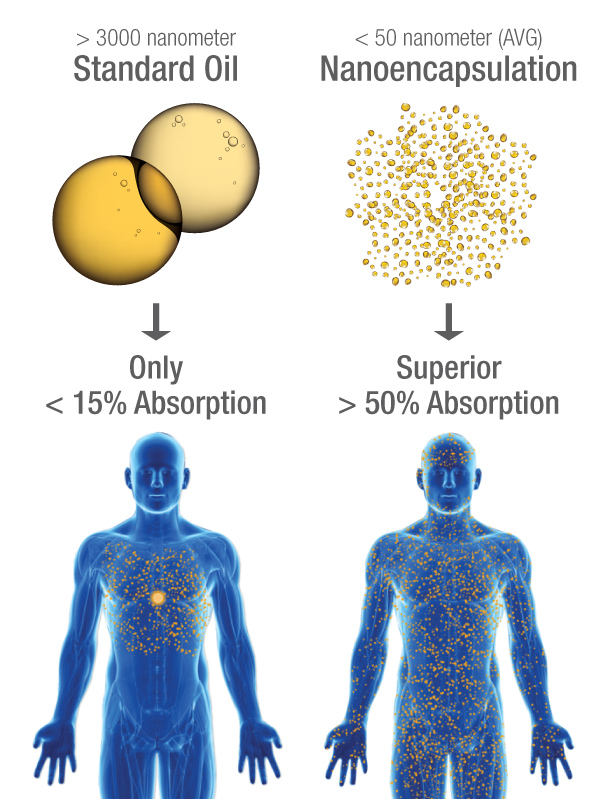
The process encapsulates active ingredients into nano-sized complexes that disperse evenly in water-based formulations, which is what gives Atrium’s oral care and whitening formulations a measurable shelf-stability advantage over standard industry formulations. Beyond shelf life, nano-complexation directly improves bioavailability and solubility, meaning active ingredients reach their target more effectively and deliver more consistent results for the end user.
Where solubility is a barrier, complexation strategies, including cyclodextrin technology, help us engineer around it. Where stability is the problem, our encapsulation approaches give your formula the structural integrity it needs to perform reliably across varying storage and shipping conditions.
Key formulation benefits:
- Improved active ingredient bioavailability and absorption
- Enhanced solubility for difficult water-insoluble compounds
- Stronger shelf stability and extended product shelf life
- Better taste and odor masking for challenging actives
- Consistent active delivery across all dosage forms.
This technology can be widely used in various categories, including pharmaceuticals, oral care, cosmetics, and dietary supplements, to enhance the effectiveness and ensure optimal customer satisfaction.
Page last updated: April 18, 2026
Frequently Asked Questions
What is nano-encapsulation and why does it matter for supplements?
Nano-encapsulation is a drug delivery technology that uses nano-scale polymer or lipid matrices to encapsulate active pharmaceutical or nutraceutical ingredients. In dietary supplements, nano-encapsulation improves active ingredient bioavailability by protecting ingredients from degradation in the GI tract, enabling faster absorption, and allowing controlled release. Atrium Scientific holds patents in nano-encapsulation technology developed by polymer science PhDs.
What is active ingredient complexation and how is it different from encapsulation?
Complexation forms non-covalent molecular associations between an active ingredient and a carrier compound (such as cyclodextrins or polymer matrices) to improve solubility, stability, and bioavailability. Unlike encapsulation, complexation operates at the molecular level rather than forming distinct nano-particles. Atrium’s R&D team applies both complexation and encapsulation approaches depending on the active ingredient and target delivery format.
Can Atrium’s encapsulation technology be used in ODF strips and sublingual films?
Yes. Atrium’s HarmonyFilm™ oral dissolving film platform integrates nano-encapsulation technology to achieve precise active loading, taste masking, and controlled dissolution profiles in sublingual and buccal film formats. This is particularly valuable for supplements with bitter actives or stability challenges in thin-film matrices.
Does Atrium file patents on formulations developed for client brands?
No. Proprietary formulations developed under contract for brand clients belong to the client. Atrium files patents on its own platform technologies, processes, and delivery systems — not on client-specific formulations. Brand clients retain full IP ownership of their custom formulas developed through Atrium’s R&D process.