
ODF vs. Capsules vs. Tinctures: Bioavailability Compared for Supplement Brands
When supplement brand owners evaluate delivery formats, the conversation usually starts and ends with capsules. They’re familiar, cost-effective, and easy to manufacture. But bioavailability — the proportion of an active ingredient that actually reaches systemic circulation and produces an effect — varies dramatically across delivery formats. For brands building products where efficacy is the core value proposition, that difference matters enormously. This guide compares three increasingly common delivery formats — oral dissolving films (ODF), capsules and tablets, and sublingual tinctures — across the metrics that matter most to supplement brands and the consumers they serve.
Why Bioavailability Matters for Supplement Brands
Bioavailability is not a marketing term — it is a measurable pharmacokinetic parameter that determines how much of your active ingredient reaches the bloodstream intact. A product with 30% oral bioavailability delivers less than a third of its labeled dose to systemic circulation. The remainder is broken down in the gastrointestinal tract, metabolized by the liver during first-pass processing, or excreted before it can exert any effect.
For brands selling sleep supplements, nootropics, immunity products, or mood support formulas, low bioavailability means consumers may not experience the results your label promises — regardless of how well-formulated the product is. Delivery format is therefore not a secondary decision. It is a primary determinant of product performance.
The First-Pass Metabolism Problem
The central bioavailability challenge for swallowed oral supplements is hepatic first-pass metabolism. When a capsule or tablet is swallowed, the active ingredients are absorbed through the intestinal wall into the portal venous system, which routes directly to the liver before entering systemic circulation. The liver metabolizes a significant fraction of many actives at this stage — sometimes reducing bioavailability by 70% or more before the ingredient ever reaches target tissues.
Melatonin is a well-documented example: oral bioavailability from swallowed tablets ranges from approximately 15% to 30% in published studies, with significant interindividual variation. The remaining 70–85% is metabolized before reaching systemic circulation. Sublingual delivery routes around this bottleneck entirely by absorbing directly through the oral mucosa into the sublingual venous drainage, bypassing the portal circulation and liver on the first pass.
Oral Dissolving Films (ODF): Bioavailability Profile
Oral dissolving films — placed under the tongue (sublingual) or against the inner cheek (buccal) — deliver active ingredients through the highly vascularized mucosal tissue of the oral cavity directly into systemic circulation. This transmucosal pathway is the defining bioavailability advantage of the ODF format.
Absorption Mechanism
The sublingual mucosa is thin, highly permeable, and richly supplied with capillaries draining into the sublingual and deep lingual veins, which feed into the internal jugular vein and directly into systemic circulation — entirely bypassing the portal system and first-pass hepatic metabolism for many actives. This enables onset speeds that can be 2–10 times faster than swallowed oral forms for appropriate actives, with meaningfully higher peak plasma concentrations per unit dose.
Best Actives for ODF Delivery
Not all supplement ingredients are suitable for transmucosal delivery. The best ODF candidates combine adequate oral mucosal permeability, stability in a polymer film matrix, and sufficient potency at the doses achievable within a standard strip (typically 1–50mg). Actives that benefit most include:
- Melatonin — rapid onset essential for sleep induction; sublingual significantly outperforms swallowed tablets on time-to-onset
- Vitamin B12 (methylcobalamin) — sublingual B12 achieves comparable or superior serum levels to intramuscular injection in several published studies
- L-theanine — fast-acting calm and focus support; transmucosal onset aligns with acute stress response windows
- CBD (cannabidiol) — oral bioavailability from swallowed capsules is highly variable (6–19%); sublingual delivery substantially improves consistency and onset
- Zinc — immune and recovery applications benefit from rapid systemic delivery
- Caffeine — faster onset than swallowed forms; relevant for pre-workout and cognitive applications
- Ashwagandha and adaptogenic extracts — where standardized extract potency is sufficient at low strip doses
Capsules and Tablets: Bioavailability Profile
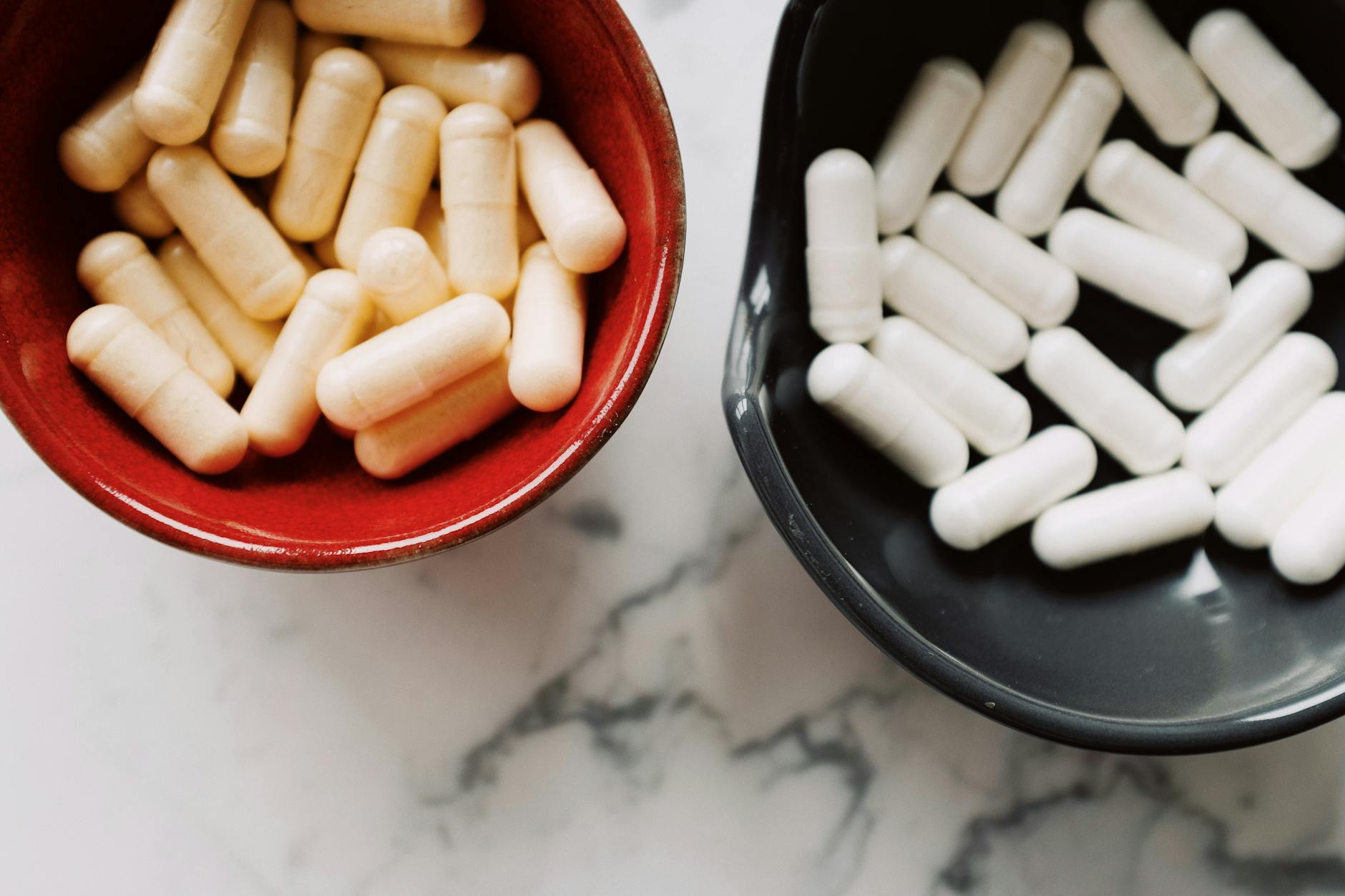
Capsules and tablets remain the dominant supplement delivery format for good reasons: they accommodate high active doses, are cost-effective to manufacture at scale, and consumers understand how to use them. However, their bioavailability profile is fundamentally constrained by gastrointestinal absorption and first-pass metabolism.
Absorption Mechanism
Swallowed capsules and tablets dissolve in the stomach and small intestine, where active ingredients are absorbed through the intestinal epithelium into the portal blood supply. Transit to the liver follows, where first-pass metabolism occurs before systemic distribution. Onset from swallowed supplements typically ranges from 30 to 90 minutes depending on gastric contents, formulation, and individual digestive variation.
When Capsules Are the Right Choice
Despite bioavailability limitations for certain actives, capsules remain the best format for many supplement applications:
- High-dose actives — magnesium, creatine, protein hydrolysates, fiber, and other ingredients requiring doses above 500mg per serving are impractical in ODF format
- Enteric-coated delivery — actives requiring intestinal (not gastric) release, such as certain probiotic strains and delayed-release enzymes
- Fat-soluble vitamins — A, D, E, K in softgel or oil-filled capsule form achieve good bioavailability via intestinal lymphatic absorption, largely bypassing portal first-pass
- Cost-sensitive formulas — capsule manufacturing is significantly less expensive per unit than ODF, which matters for high-dose commodity supplements
Sublingual Tinctures: Bioavailability Profile
Sublingual liquid tinctures — drops held under the tongue before swallowing — offer a similar transmucosal absorption pathway to ODF strips, and have been used in herbal medicine for centuries. However, their practical profile differs meaningfully from ODF in several respects relevant to brand owners.
Absorption Mechanism
When held sublingually for 60–90 seconds before swallowing, a portion of the active ingredient in a tincture is absorbed transmucosally. The remainder is swallowed and follows the standard oral route with associated first-pass losses. The ratio of transmucosal to oral absorption depends heavily on patient compliance with hold time — a variable that is difficult to control in a consumer setting.
Limitations vs. ODF
Tinctures present several practical disadvantages compared to ODF strips for modern supplement brands:
- Dosing imprecision — dropper administration introduces significant unit-to-unit dose variation compared to the uniform active distribution in a precision-manufactured ODF matrix
- Portability — liquid bottles are not practical for on-the-go, travel, or single-serving use cases where ODF strips excel
- Compliance variability — the therapeutic benefit of sublingual absorption requires holding the liquid under the tongue for at least 60 seconds; many consumers swallow immediately
- Stability — liquid formulations are generally more susceptible to oxidation, microbial contamination, and temperature sensitivity than solid ODF matrices
- Alcohol content — traditional herbal tinctures use ethanol as a solvent, which limits market access for consumers avoiding alcohol
Head-to-Head Comparison
| Feature | ODF Strip (Sublingual) | Capsule / Tablet | Sublingual Tincture |
|---|---|---|---|
| Bioavailability | High — transmucosal bypass of first-pass | Variable — subject to first-pass metabolism | Moderate — partial transmucosal, partial oral |
| Onset speed | Fast — seconds to minutes | Slow — 30 to 90 minutes | Fast to moderate — depends on hold compliance |
| Dose precision | Very high — uniform film matrix | Very high — fill weight controlled | Moderate — dropper variation |
| Max dose per serving | Low — typically 1 to 50mg | High — 500mg to several grams | Moderate — limited by sublingual volume tolerance |
| Water required | No | Yes | No |
| Portability | Very high — individual sachets | High — bottles and blister packs | Low — liquid bottle |
| Consumer compliance | Very high — dissolves automatically | Moderate — swallowing required | Moderate — hold time compliance variable |
| Shelf differentiation | High — premium strip format | Low — commodity appearance | Moderate |
| Manufacturing cost per unit | Higher | Lower | Moderate |
| Pediatric and geriatric suitability | Excellent | Poor to moderate | Moderate |
| Alcohol-free options | Yes | Yes | Limited |
When Should Brands Choose ODF Over Capsules?
ODF strips are the superior choice when your product brief requires one or more of the following:
Rapid Onset Is a Core Product Claim
Sleep, acute stress relief, fast-acting energy, and pre-workout focus supplements all benefit from formats that deliver actives quickly. If your label implies or states fast action, ODF’s transmucosal onset is a scientific foundation for that claim that capsules cannot match.
Your Target Active Has Significant First-Pass Losses
If your key active ingredient loses substantial potency through hepatic first-pass metabolism when swallowed — melatonin, CBD, certain polyphenols, and sublingual B12 being the clearest examples — ODF delivery can meaningfully improve product performance at the same label dose.
Product Differentiation Is a Priority
The premium strip format commands higher retail price points than equivalent capsule products, particularly on DTC and Amazon channels where visual packaging drives conversion. For brands building a premium positioning, ODF packaging communicates innovation and science at the point of sale.
Your Consumer Has Swallowing Challenges
Pediatric, geriatric, and dysphagic consumers represent a substantial and underserved supplement market segment. ODF strips dissolve without swallowing, making them uniquely suitable for populations where capsules are impractical or unsafe.
How Atrium Scientific Group Supports ODF Manufacturing
Atrium Scientific Group manufactures oral dissolving films for dietary supplement and nutraceutical brands from our USA-based, cGMP facility. Our formulation team supports active ingredient selection, polymer system development, flavor masking, and analytical testing from pilot batch through commercial scale. We work with established brands, startup founders, and R&D organizations bringing ODF supplement products to the U.S. and international markets.
If you are evaluating whether ODF is the right format for your next product, contact our formulation team to discuss your active ingredient, target dose, and performance goals.
Frequently Asked Questions
Is ODF bioavailability always better than capsules?
Not for all actives. ODF’s bioavailability advantage is most pronounced for ingredients with significant first-pass metabolism and adequate oral mucosal permeability — melatonin, B12, CBD, and L-theanine being strong examples. For fat-soluble vitamins, high-dose minerals, and enteric-targeted actives, capsules or softgels may remain the superior format. Format selection should always be driven by the pharmacokinetics of your specific active ingredient.
Can I achieve the same bioavailability improvement by simply increasing the capsule dose?
Partially, but not equivalently. Increasing dose compensates for first-pass losses numerically but does not replicate the faster onset achievable through transmucosal delivery. For applications where speed of effect matters — sleep induction, acute calm, fast energy — dose escalation in a capsule does not solve the onset latency problem that ODF addresses.
What is the maximum active dose achievable in an ODF strip?
Most ODF manufacturing processes accommodate active loads of 1 to 50mg per strip within standard dimensions. Higher doses are possible with larger strip sizes or multilayer film constructions, but formulation complexity and cost increase accordingly. Your CMO’s formulation team should evaluate dose feasibility for your specific active during the development phase.
Are sublingual tinctures and ODF strips interchangeable?
They share a similar absorption pathway but differ significantly in dose precision, portability, compliance reliability, and manufacturing scalability. ODF strips deliver a precisely metered dose that dissolves automatically without any hold-time compliance requirement. For most modern supplement applications, ODF offers a more consistent consumer experience than tinctures.
How much more expensive is ODF manufacturing compared to capsules?
ODF manufacturing typically costs 2–4 times more per unit than equivalent capsule production. This cost differential is generally offset by higher retail price points — ODF supplement strips command a premium across DTC and marketplace channels — and by the bioavailability improvements that support stronger efficacy claims and consumer satisfaction. The economics are strongest for high-value actives in fast-acting applications.
Conclusion
Bioavailability is one of the most underutilized competitive advantages available to supplement brands. Capsules dominate the market by default, not because they are the optimal delivery format for most actives. For brands building products where onset speed, absorption consistency, and consumer compliance matter — sleep, energy, mood, immunity, and cognitive health being the clearest categories — oral dissolving films represent a scientifically grounded upgrade that capsules and tinctures cannot match at equivalent doses.
The right format depends on your active ingredient, your target dose, and your brand positioning. Atrium Scientific Group’s formulation team can help you evaluate the options. Contact us to discuss your next product development project.