Mucoadhesive Buccal Films: Slow-Release ODF Technology & Bioavailability
While fast dissolving oral films have transformed supplement convenience, mucoadhesive buccal films represent the advanced frontier of oral thin film technology — engineered not for speed of dissolution, but for prolonged mucosal contact and enhanced systemic bioavailability. For private label brands working with actives that suffer from poor oral absorption or extensive first-pass metabolism, mucoadhesive buccal films offer a scientifically differentiated delivery platform that standard tablets, capsules, and even fast dissolving films cannot match.
At Atrium Scientific, our slow-release ODF technology platform encompasses full formulation development, mucoadhesive polymer selection, and scalable cGMP manufacturing of buccal films for dietary supplement and specialty product applications.
What Are Mucoadhesive Buccal Films?
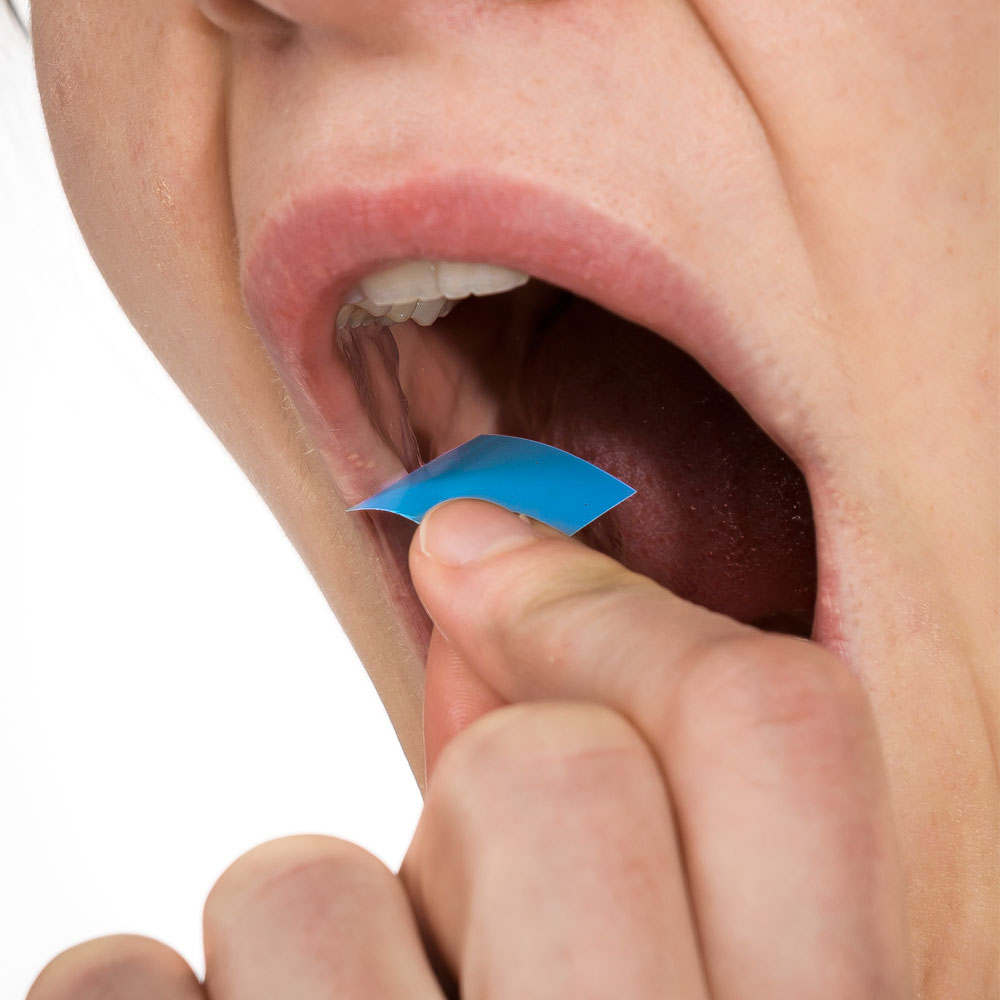
Mucoadhesive buccal films are thin polymer matrices that adhere to the oral mucosal tissue — specifically the buccal mucosa (inner cheek) or sublingual mucosa (under the tongue) — and remain in place for an extended period ranging from 20 minutes to several hours. During this residence time, the active ingredient permeates through the mucosal epithelium directly into the systemic circulation, bypassing the gastrointestinal tract and first-pass hepatic metabolism entirely.
This transmucosal delivery mechanism distinguishes mucoadhesive buccal films from conventional oral dosage forms. Rather than dissolving rapidly and releasing the active into the GI tract, a mucoadhesive film acts as a controlled-release mucosal depot — delivering actives slowly and continuously while adhered in place.
A landmark comprehensive review of oral thin film technology published on PubMed Central highlights mucoadhesive buccal films as one of the most promising platforms for improving bioavailability of poorly absorbed actives, with growing commercial applications in wellness, hormonal health, and precision nutrition.
The Science of Mucoadhesion
How Mucoadhesive Polymers Work
Mucoadhesion occurs through multiple mechanisms at the polymer–mucosa interface. When a mucoadhesive film is placed against the mucosal tissue, the polymer chains hydrate and interpenetrate with the glycoprotein (mucin) layer covering the epithelium. This physical entanglement is reinforced by hydrogen bonding, electrostatic interactions, and van der Waals forces — creating a bond strong enough to resist displacement by saliva, tongue movement, and swallowing.
The strength and duration of mucoadhesion depends on polymer molecular weight, degree of hydration, and the presence of functional groups capable of interacting with mucin. Formulation scientists at Atrium Scientific optimize these parameters to achieve target residence times for each specific product.
Key Mucoadhesive Polymers in ODF Formulation
The following polymer systems form the foundation of Atrium Scientific’s mucoadhesive buccal film platform:
- Carbomers (Carbopol): Cross-linked polyacrylic acid polymers with exceptional mucoadhesive strength. Carbopol forms high-viscosity hydrogels on hydration, maximizing contact area with the mucosal surface. Particularly effective for sublingual and buccal applications requiring residence times of 30+ minutes.
- Sodium Alginate: A natural polysaccharide derived from brown algae with good mucoadhesive properties and a favorable safety profile. Sodium alginate gels rapidly on contact with calcium ions in saliva, forming a cohesive, adherent matrix.
- Carrageenan: A sulfated polysaccharide with strong mucoadhesive properties and the ability to form thermoreversible gels. Carrageenan is increasingly used in clean-label, plant-derived ODF formulations.
- High-MW HPMC: Higher molecular weight grades of hydroxypropyl methylcellulose (K-series) provide mucoadhesion alongside film-forming capability, making them useful as single-polymer matrices for moderate-adhesion applications.
- Chitosan: A naturally derived cationic polymer with inherent mucoadhesive strength due to electrostatic interaction with the negatively charged mucin layer. Chitosan also exhibits mild permeation-enhancing properties, making it dual-functional in buccal film formulations.
Slow-Release Buccal Film vs. Fast Dissolving Film: Key Differences
Understanding the distinction between fast and slow-release oral film formats is essential for brands choosing the right delivery platform:
- Dissolution time: Fast dissolving films disintegrate in 15–30 seconds. Mucoadhesive buccal films remain intact for 20 minutes to 4+ hours.
- Absorption pathway: Fast dissolving films release actives into saliva for GI absorption. Buccal films deliver actives transdermally through the mucosal epithelium directly into systemic circulation.
- First-pass bypass: Buccal delivery bypasses hepatic first-pass metabolism; fast dissolving oral films do not.
- Onset time: Both formats provide faster onset than tablets/capsules, but the pharmacokinetic profile differs — buccal films produce more sustained plasma levels vs. the sharp initial peak of fast dissolving formats.
- Best-suited actives: Fast dissolving films work well for high-solubility, moderate-dose actives; mucoadhesive films excel with low-dose, high-potency, or extensively metabolized actives.
For a detailed comparison of ODF with other delivery formats, see ODF vs. capsules vs. tinctures: bioavailability compared.
Bioavailability Advantages of Buccal and Sublingual Delivery
The bioavailability advantage of mucoadhesive buccal films over conventional oral formats is one of their most compelling attributes for supplement brands. Research published on PubMed Central demonstrates that optimized buccal film formulations can achieve up to 10.6-fold permeation enhancement compared to unformulated reference solutions — a significant advantage for actives with inherently low oral bioavailability.
Key bioavailability mechanisms include:
- Bypass of GI first-pass metabolism: Actives absorbed through the buccal mucosa enter systemic circulation via the jugular vein, bypassing the portal circulation and hepatic extraction. This is particularly valuable for actives like melatonin, which undergoes ~90% first-pass hepatic extraction when swallowed.
- Avoidance of GI degradation: Acid-labile or enzyme-sensitive actives are protected from the GI environment entirely.
- Controlled plasma concentration profile: Sustained mucosal release produces flatter, more consistent plasma concentration curves compared to the rapid peaks of fast dissolving or swallowed formats — beneficial for sleep supplements, mood actives, and sustained-energy products.
- Faster onset vs. GI administration: The buccal mucosa’s rich vascular supply enables faster absorption onset than GI absorption, even compared to fast dissolving films that are ultimately swallowed.
Active Ingredients Best Suited for Slow-Release Mucoadhesive Films
Vitamins and High-Value Nutraceuticals
Vitamin B12 (methylcobalamin) is one of the most commercially significant actives in buccal film delivery. Sublingual B12 administration through mucoadhesive films achieves significantly higher absorption than oral tablets in individuals with intrinsic factor deficiency or GI absorption issues. Similarly, melatonin delivered via buccal film produces faster sleep onset with lower doses due to pre-systemic first-pass avoidance.
Botanical Extracts and Adaptogens
Many botanical extracts face significant first-pass metabolism challenges — ashwagandha withanolides, curcumin, and certain terpene fractions from hemp extracts are prominent examples. Mucoadhesive buccal film delivery can dramatically improve the effective dose reaching systemic circulation. Atrium Scientific’s formulation team evaluates each botanical for mucosal permeability, molecular weight, and compatibility with buccal film polymer systems.
Specialty Nutraceuticals and Functional Actives
Glutathione, NAD+ precursors (NMN, NR), CBD, CBN, and melatonin analogs are increasingly being explored in buccal film formats for the same bioavailability rationale. Brands in the longevity, sleep optimization, and cognitive performance spaces are finding that buccal films command premium positioning and demonstrate measurable product differentiation.
Manufacturing Slow-Release Films: Formulation Challenges
Controlling Residence Time
Achieving a target residence time (the duration the film remains adhered to the mucosa) requires precise control of polymer type, molecular weight, crosslink density, and the ratio of mucoadhesive to film-forming polymers. Too low a mucoadhesive polymer concentration and the film detaches prematurely; too high and the film becomes excessively rigid or uncomfortable. Atrium Scientific’s formulation scientists use in vitro mucoadhesion testing (textural analysis, wash-off testing, and rotating cylinder dissolution models) to optimize residence time before advancing to clinical evaluation.
Permeation Enhancement
Many actives of interest for buccal delivery have molecular weights, lipophilicity profiles, or ionization states that limit passive mucosal permeation. Permeation enhancers — including surfactants (sodium lauryl sulfate, polysorbates), fatty acids (oleic acid), and chelating agents (EDTA) — are incorporated at sub-irritation concentrations to temporarily loosen the mucosal epithelial junction and enhance active transport. The selection and concentration of permeation enhancers requires careful safety and tolerability evaluation.
API Loading and Content Uniformity
Achieving uniform distribution of the active pharmaceutical ingredient (API) across the cast film web is critical for dose accuracy — particularly for low-dose, high-potency actives in mucoadhesive films. Atrium Scientific employs high-shear mixing, suspension milling for insoluble actives, and rigorous in-process content uniformity sampling to ensure each unit dose delivers within ±5% of the label claim.
Regulatory and Quality Considerations for Mucoadhesive Films
Mucoadhesive buccal films for dietary supplements are manufactured under the same regulatory framework as other supplement formats: 21 CFR Part 111 (cGMP for dietary supplements) in an FDA-registered facility. Key quality documentation includes:
- Certificate of Analysis (COA) covering identity, potency, dissolution/disintegration, moisture, and microbial limits
- Accelerated and real-time stability data under ICH Q1A conditions
- In vitro mucoadhesion testing data (for internal development validation)
- Permeation testing data using ex vivo or synthetic membrane models
- Full batch records, SOPs, and traceability documentation
Atrium Scientific’s quality management system supports full regulatory documentation for brands entering FDA-regulated supplement markets domestically and internationally.
Why Atrium Scientific for Mucoadhesive Buccal Film Manufacturing
Atrium Scientific’s slow-release ODF platform is purpose-built for private label brands that need more than standard contract manufacturing. Our mucoadhesive buccal film capabilities include:
- Mucoadhesive polymer expertise across carbomers, alginates, carrageenan, chitosan, and HPMC-K series
- In-house permeation enhancement formulation development
- Precise control of residence time for 20-minute to multi-hour profiles
- Full biocompatibility and tolerability assessment for novel excipient combinations
- Scalable cGMP manufacturing from clinical batch to commercial production
- Private label, white label, and custom formulation services
- Regulatory documentation support for domestic and international markets
To learn more about how our oral dissolving film technology platform can serve your brand, explore our ODF innovation capabilities or review the full range of Atrium Scientific contract manufacturing services. Ready to start a project? Contact our formulation team today.
Also compare our fast dissolving film platform — see our guide to fast dissolving oral films for side-by-side technology comparison.
Frequently Asked Questions
What is a mucoadhesive buccal film?
A mucoadhesive buccal film is a slow-dissolving oral thin film designed to adhere to the buccal (cheek) or sublingual (under-tongue) mucosa for an extended period. Unlike fast dissolving films that disintegrate in seconds, mucoadhesive films maintain contact with the mucosal tissue for minutes to hours, enabling prolonged or sustained active ingredient permeation directly into systemic circulation.
How do mucoadhesive buccal films differ from fast dissolving oral films?
The key difference is residence time and absorption mechanism. Fast dissolving films dissolve in under 30 seconds and deliver actives primarily through swallowing or immediate mucosal contact. Mucoadhesive buccal films adhere to mucosal tissue for 20 minutes to several hours, enabling sustained transmucosal permeation that bypasses first-pass hepatic metabolism — resulting in higher bioavailability for many actives.
Which active ingredients are best suited for mucoadhesive buccal films?
Mucoadhesive buccal films are ideal for low-dose, high-potency actives where bypassing first-pass metabolism significantly improves efficacy. Well-suited ingredients include melatonin, B12 (methylcobalamin), hormones, cannabinoids (CBD, CBN), nicotine, and certain botanical extracts with poor oral bioavailability. High-dose actives or those with poor mucosal permeability are generally better suited to other formats.
What polymers are used in mucoadhesive buccal film formulation?
Key mucoadhesive polymers include carbomers (Carbopol), sodium alginate, carrageenan, high-molecular-weight HPMC, and chitosan. These polymers form hydrogen bonds, physical entanglement, and electrostatic interactions with the mucosal glycoprotein layer to achieve adhesion. Formulations often combine a mucoadhesive polymer with a film-forming polymer for the right balance of adhesion and mechanical properties.
Are mucoadhesive buccal films regulated differently than fast dissolving films?
For dietary supplements, both film types are regulated under 21 CFR Part 111 (cGMP for dietary supplements) and require the same documentation — COA, stability data, label compliance. For drug products, mucoadhesive buccal films delivering controlled-release drug substances may require additional FDA review depending on the NDA/ANDA pathway. Atrium Scientific manufactures supplement-grade buccal films under FDA-registered cGMP conditions.
What bioavailability advantages do mucoadhesive buccal films provide?
By delivering actives directly through the oral mucosa into the bloodstream, mucoadhesive buccal films bypass the GI tract and first-pass hepatic metabolism. Research published in PubMed Central (PMC9694529) has demonstrated up to 10.6-fold permeation enhancement with optimized buccal film formulations. This makes the format especially valuable for actives that are extensively metabolized when administered orally.