
Supplement Stability Testing: ICH Guidelines, Shelf-Life Claims & What Every Brand Needs to Know
Supplement stability testing is one of the most scientifically important — and most frequently overlooked — steps in bringing a dietary supplement to market. Every expiration date printed on a supplement label represents a claim: that the product will remain safe, potent, and within its labeled specifications until that date under stated storage conditions. Stability testing is how you prove that claim. Without it, your expiration date is a guess — and a legally and commercially risky one.
This guide covers what supplement stability testing involves, the ICH guidelines that define industry-standard conditions, the difference between accelerated and real-time stability studies, which parameters are tested, and what data you need in hand before you can confidently launch your product.
What Is Supplement Stability Testing and Why Does It Matter?
Stability testing systematically evaluates how a supplement’s quality attributes change over time under defined environmental conditions — temperature, humidity, light, and packaging. The results establish a shelf life (the period during which the product remains within its labeled specifications) and confirm that the product will meet label claims for its entire stated shelf life.
Per FDA dietary supplement regulations, manufacturers are responsible for ensuring that products are not adulterated — which includes ensuring that products meet their labeled potency through expiration. Brands that make structure/function claims are implicitly asserting the product delivers the stated dose for the duration of its shelf life. Stability data is what backs that assertion up.
Practically speaking, stability failures are costly: product recalls, regulatory action, retailer chargebacks for short-dated or degraded product, and reputational damage are all real consequences of inadequate stability planning.
ICH Stability Guidelines for Dietary Supplements
The pharmaceutical industry’s International Council for Harmonisation (ICH) provides the most rigorous and widely accepted framework for stability testing. While ICH guidelines technically address drug products, the dietary supplement industry has broadly adopted ICH Q1A(R2) conditions as the de facto standard because they are well-defined, reproducible, and defensible to retailers, auditors, and regulators.

ICH Q1A(R2): Long-Term and Accelerated Testing Conditions
ICH Q1A(R2) defines the following storage conditions for stability studies:
- Long-term (real-time): 25°C ± 2°C / 60% ± 5% RH for products labeled for storage at room temperature; studies run for the full claimed shelf life (typically 24 months)
- Intermediate: 30°C ± 2°C / 65% ± 5% RH; used as a check point between accelerated and long-term
- Accelerated: 40°C ± 2°C / 75% ± 5% RH for a minimum of 6 months; provides predictive data early in development
- Refrigerated products: Long-term 5°C ± 3°C; accelerated 25°C ± 2°C / 60% ± 5% RH
Stability samples are tested at defined time points: typically T=0, 3, 6, 9, 12, 18, and 24 months for long-term studies; T=0, 3, and 6 months for accelerated studies.
ICH Q1B: Photostability Testing
ICH Q1B governs photostability — evaluation of a product’s susceptibility to degradation from light exposure. For supplements containing light-sensitive actives (CoQ10, certain carotenoids, riboflavin, retinol), photostability testing confirms that the packaging provides adequate protection. If the product shows significant photodegradation, the solution may be an opaque or UV-blocking container rather than a formulation change.
Key Stability Parameters Tested for Dietary Supplements
Chemical Stability: Potency Retention
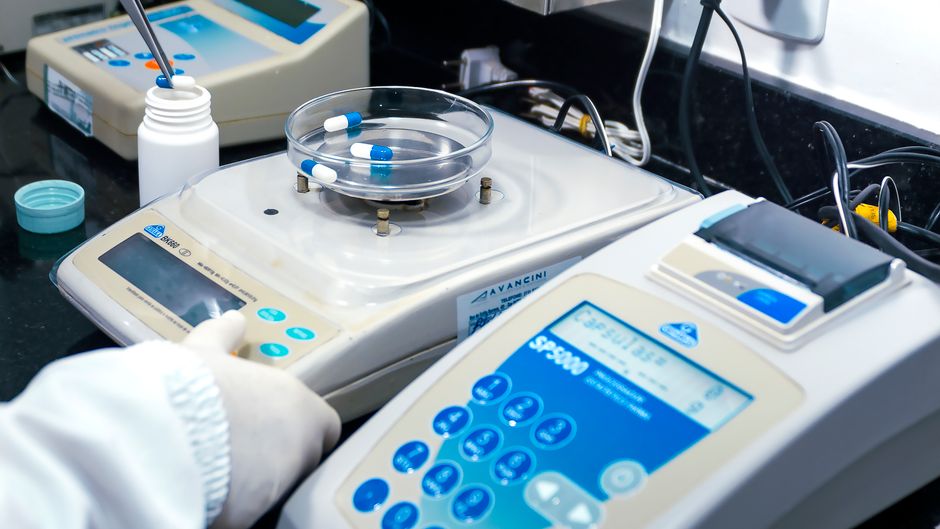
Assay testing measures the concentration of the active ingredient(s) at each stability time point and compares it against the initial T=0 value and the labeled claim. Typical acceptance criteria for supplements is ≥90% of labeled claim through expiration (some actives warrant tighter specifications, e.g., ≥95% for standardized botanical extracts). Overage is commonly built into formulations at the T=0 manufacturing stage to account for predictable degradation — a practice that must be reflected in the master formula documentation.
Physical Stability: Appearance, Texture, and Dissolution
Physical stability evaluation assesses changes in color, odor, hardness, friability, disintegration or dissolution rate, and in the case of oral dissolving films (ODF), film integrity and disintegration time. Physical changes often precede chemical degradation and can signal packaging failures (moisture ingress) or formulation incompatibilities. For fast dissolving oral films and mucoadhesive buccal films, dissolution time stability is a particularly critical specification because the product’s therapeutic mechanism depends on predictable disintegration kinetics.
Microbial Stability
Microbial limit testing confirms that total aerobic plate count (TAPC), yeast and mold counts, and specified pathogens (Salmonella, Staphylococcus aureus, E. coli) remain within USP <2021> or <61>/<62> limits throughout the shelf life. Products with higher water activity — gummies, chewables, liquid-filled capsules — require more rigorous microbial stability monitoring than dry powder formats. Packaging that allows moisture ingress can cause microbial stability failures in products that pass initial testing.
Stability Testing by Supplement Format
Different supplement dosage forms present distinct stability challenges:
- Capsules and softgels: Monitor fill content potency, shell integrity, moisture content, and disintegration; softgel shells are susceptible to cross-linking under heat and humidity
- Powders and stick packs: Focus on moisture content, caking/flowability, and potency of oxidation-sensitive actives; packaging selection (foil barrier vs. HDPE) is critical
- Oral dissolving films (ODF): Disintegration time, film flexibility and tensile strength, moisture content, and active potency — moisture is the primary enemy of fast dissolving films
- Tablets: Hardness, friability, disintegration/dissolution, coating integrity, and potency
- Gummies: Water activity, texture (hardness, stickiness), microbial limits, and potency — among the most stability-challenging formats due to high water activity
What Stability Data You Need Before Launch
A responsible supplement launch requires, at minimum:
- T=0 data: Full release testing at time of manufacture — the baseline against which all stability results are compared
- 3-month accelerated data (40°C/75% RH): Minimum baseline for a launch decision; confirms no rapid early degradation
- 6-month accelerated data: Supports an 18–24 month shelf-life claim by convention (the “6-month accelerated = 2-year real-time” rule of thumb, which must be validated by concurrent real-time data)
- Ongoing real-time study: Must be initiated at T=0 and run continuously; real-time data eventually supersedes accelerated data as the definitive shelf-life support
Stability studies should be initiated at the start of commercial production — or even during development batches for novel formulations. Waiting until after launch exposes the brand to the risk of discovering stability failures post-market. See our guide to supplement certificates of analysis for details on the documentation each stability-compliant batch produces.
How Atrium Scientific Approaches Supplement Stability Testing
Atrium Scientific initiates stability programs for each product formulation at the time of commercial manufacturing. Our quality system includes:
- ICH Q1A(R2)-aligned accelerated and long-term stability protocols
- In-house environmental chambers calibrated to ICH temperature and humidity conditions
- Multi-timepoint potency testing using validated analytical methods
- Physical appearance, dissolution, moisture content, and microbial limit testing at each pull point
- Formal stability reports issued with each study completion
- Retains maintained in controlled storage for the product’s full shelf life
Our approach to regulatory compliance — from cGMP facility standards through stability testing — is designed to protect our clients from regulatory risk and provide the documentation backbone that premium retailers and international markets require. Explore our full contract manufacturing services or contact our team to discuss your stability requirements.
Related: Understanding the regulatory framework your stability data supports — see our guide on FDA registered vs. FDA approved supplements and what compliance really requires.
Frequently Asked Questions
What is supplement stability testing?
Supplement stability testing is a systematic process of evaluating how a dietary supplement’s quality attributes — potency, physical appearance, dissolution characteristics, and microbial limits — change over time under defined environmental conditions. The goal is to establish an accurate shelf life (expiration date) and confirm that the product will meet its label claims throughout the entire stated shelf life under specified storage conditions.
How long does supplement stability testing take?
Real-time stability testing takes as long as the claimed shelf life — typically 18 to 24 months for most supplements. To accelerate the timeline for product launch, manufacturers use ICH Q1A(R2) accelerated testing conditions (40°C / 75% RH for 6 months), which allows tentative shelf-life claims while real-time data continues to accumulate. Most brands can launch with accelerated data and update to real-time data as it becomes available.
What are the ICH Q1A accelerated stability testing conditions?
ICH Q1A(R2) defines three stability storage zones for accelerated testing. For products intended for temperate climates (Zone I/II), the accelerated condition is 40°C ± 2°C and 75% ± 5% relative humidity for 6 months, with intermediate testing at 30°C / 65% RH. For products intended for hot/humid climates (Zone III/IV), the long-term condition is 30°C / 65% or 30°C / 75% RH. These conditions simulate the thermal and humidity stress a product might encounter over its stated shelf life.
What stability parameters are tested for dietary supplements?
Supplement stability studies evaluate: (1) assay/potency — confirms the active ingredient remains within specification (typically ≥90% of label claim at expiry); (2) physical appearance — color, odor, texture, and disintegration or dissolution; (3) moisture content — critical for hygroscopic actives and oral films; (4) microbial limits — total aerobic count, yeast/mold, and absence of specified pathogens; (5) packaging integrity — confirms the container-closure system maintains its barrier properties over time.
When do I need stability data — before or after launch?
Ideally, accelerated stability data supporting your expiration date claim should be in hand before commercial launch. Brands that launch without any stability data are exposing themselves to liability if products degrade before the printed expiration date. At minimum, 3-month accelerated data at ICH conditions is considered a reasonable baseline for initial launch, with full 6-month accelerated data and ongoing real-time studies running in parallel. Your contract manufacturer should initiate stability studies at the start of development, not after commercial production begins.
What is the difference between accelerated and real-time stability studies?
Accelerated stability studies use elevated temperature and humidity conditions to simulate aging at a faster rate, providing early predictive data. Real-time stability studies store samples under the product’s labeled storage conditions (e.g., room temperature, 25°C/60% RH) for the full claimed shelf life. Real-time data is the definitive basis for expiration dating; accelerated data provides early support. Both are typically run simultaneously, with real-time data continuously validating the accelerated predictions.